Showing posts with label Touristing. Show all posts

Saturday, 21 January 2012

The Dogs!

Waiting.
On Saturday 21st January, Cogne was home to the Italian national dog sledding championships - and the quiet cross-country ski piste was over-run with dogs and their owners. This sport leaves climbing of all varieties in the dust when it comes to being an expensive and time-consuming hobby: how are these teams of animals fed and exercised, not to mention trained?! And each team came in their specially kitted-out van, too.

Once in the harness, they had to be restrained by their owners to stop them charging off at full pelt: they knew what they needed to do, and couldn't wait to get running.

And ...
... they're off!

This was no Iditarod - the circuits were only 10km or so - and being a time trial with a number of categories (different dogs, different numbers of dogs and even a guy with only one dog, who skied behind him), we sadly couldn't place any bets on the teams. Still, a crazy sport to watch!


Wednesday, 7 December 2011

All fairy tale castles ...


... especially this one, Neuschwanstein ...


... need a princess or two.

Wednesday, 23 November 2011

Verdon (Part III)


Our last days in Verdon were spent enjoying the scenery,
and making a leisurely tour around the gorge. 
We'll let these pictures speak for themselves.


Wednesday, 22 June 2011

Venice (or, unexpected free parking)

Our ferry arrived in Venice early in the morning, almost 24 hours since leaving Igoumenitsa. We'd spent that time curled up in our (Camper Special Bonus!) cabin, playing Free Civ, snoozing and generally trying to avoid the fact we were trapped on a rather dull boat for an entire day.

We needed to stretch our legs and do something different -and Venice was right there, waiting to be explored.
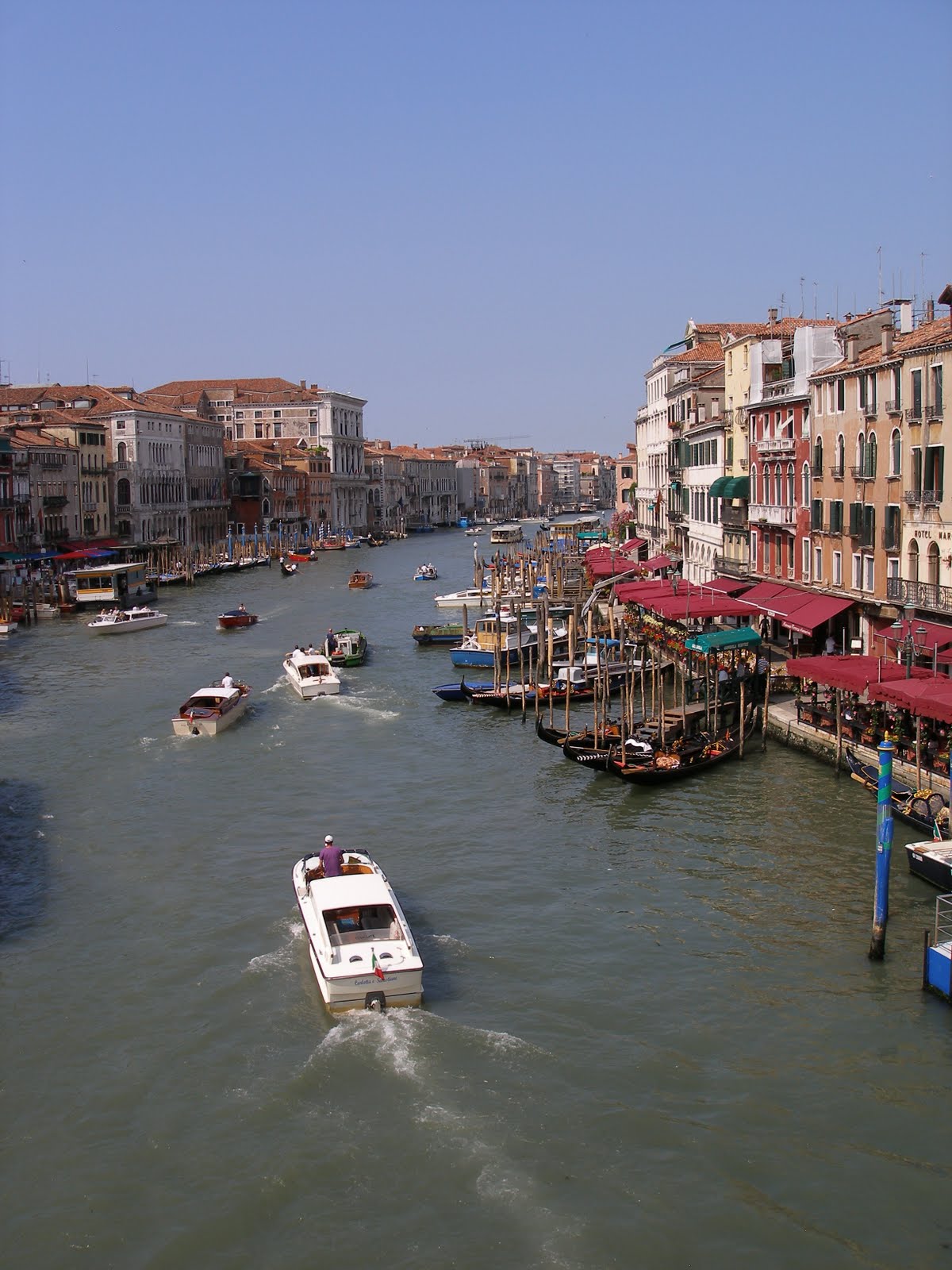
Driving off the ferry, our first problem was parking - in a congested island city, famous now for its tourism and lack of streets, where do you put a van? Answer: just over the bridge off the island, in the public car parking, where the council has installed signs to say you must pay but hasn't yet got around to installing the machines to do so. And after five minutes on the bus, we were back in the canal zone with all the other tourists, cameras in hand.

We started by following the crowds to Piazza San Marco (of course), enjoying the canals, winding laneways and old buildings along the way. Once there, we ditched the tourist trail and spent most of the day just a little lost.

We quickly worked out that buying an espresso and drinking it at the bar (E1), before ducking upstairs to use the cafe's loos, is far better value than using a public toilet (E1.50), and as entrance to any one of the museums on Piazza San Marco gives you entrance to all the others, there's no point in waiting at the most popular Doge's Palace to get in ... better to check out the Correr first and waltz past the line to the Doge's fine lodgings once you have your ticket.
Peak hour: this was the start of a gondola-traffic-jam.
We thought about taking a gondola. We could be one of "those" couples, sitting romantically in the love seat being seranaded in Italian by someone wearing a straw hat and stripey shirt. But does that sound like us? Not really. Instead we took a break from walking around in an alley that ended in a canal, and we sat and watched an entire log jam of gondolas float by ... noticing that the only tourists enjoying themselves were the ones with a bottle of prosecco, that straw hats are out of fashion and that there's nothing romantic about being stuck on a small vessel with an accordian when the player only knows one song, we were pretty pleased with our decision to just walk around town.

What else? We bought take away pizza for lunch, eating it under one of the many small bridges and watching more boats of many different shapes and sizes go by. We found the residential area, looking dilapadated and perhaps a little empty, but providing a fascinating glimpse into how one does laundry here (how much falls of the lines and ends up in the water?). Although we'd be heading in the right direction, we never really knew where we were and often met with dead-ends ... but that was OK.

And in the evening, after dinner in a small courtyard restaurant, we joined the students for a plastic tumbler or three of "spritzer" - Campari, white wine and soda, on a hot evening, standing on yet another bridge over yet another canal.

All up, a pretty perfect day.

Sunday, 19 June 2011

Meteora

Meteora was hot.

So, feeling very much like lazy tourists, we spent a large quantity of our time there by the campsite's swimming pool. From the side of the pool, you could admire the tall rock pillars with their precariously perched monasteries above you (and not even raise a sweat).

The chosen route: up this pillar on the left.
Not wanting to fork out for the comprehensive guidebooks to the area for only a day or so, we tracked down some other climbers for information. Two friendly Germans pointed us in the direction of a route called "Traumfiler", or something like that, that ran up the corner of a large pillar near our campsite. Well within our abilities, it seemed perfect for us the next day.


Jen has to be honest here - she doesn't like conglomerate rock, and particularly doesn't like conglomerate rock with very spaced bolts! So, swearing and sweating, she followed Mark's lead, very happy not to be on the sharp end and feeling not just like a lazy tourist, but like a bad climber as well.

Mark really enjoyed the route and had a great time.


We were both agreed that the view from the top was even better than the view from the pool. (Hopefully the pictures convey the stunning scenery!)

But as we were at risk of dehydration from perspiration, however, it was time to head back to those cool, blue waters ... 

Thursday, 16 June 2011

Athens

We arrived in Athens to the news of a general strike. This apparently meant that most of the main monuments would be closed (including the Acropolis). We headed into the city regardless, figuring it would still be more interesting than the campsite.

We got off at the metro station right near Parliament House, where all the protesters had gathered. There were lots of people there and it was busy, but most of them were standing around with a coffee and a cigarette having a chat! There were also all manner of banners and fliers being handed out, and also a small tent city set up by the die-hard protesters who have been there for months, but in general the atmosphere was relaxed and friendly. 


Nevertheless, we decided not to stick around.


And whilst the Acropolis was closed, the Ancient Agora was still open, there are many parks that surround the ancient downtown sites that are very pretty to walk through (and thankfully have lots of trees and shade - it's hot!) and the very new Acropolis Museum was also open - and that was really very interesting, worth seeing before going to the actual Acropolis the next day, and pleasantly air-conditioned, too.


On our way back much later in the afternoon, we ended up passing through the Parliament House station again ... and things were a little different. Exactly the same atmosphere amongst the protesters, with everyone holding a coffee and a cigarette, but there were a few bin fires, a few random olive trees planted in the road, and a strong stink in the air that burned your eyes, nose and throat. 


It had been a good decision not to stick around. 


However, we did like the chain of people passing bottles down a line to a fountain, where the bottles were filled, and then sent from the fountain to the fires - clearly the vast majority of people there didn't want trouble, and were happy to help clean up. 
 

And day two in Athens? Well the tent city was still in place and many of the protesters were still there, smoking and drinking coffee. And as the Acropolis and other sights were now open, we competed with the crowds to complete our sightseeing.

Thursday, 21 April 2011

Bafa Golu


Once upon a time, a long, long time ago, there was a large, walled city on the edge of a natural harbour. It was close to the trade routes of the Aegean sea, yet well protected by both its location and more than 5km of stone walls, with numerous towers. It was called Herakleia, or sometimes, Latmos.

Once a tomb, now a pond.
One of many towers on the walls.


After some time, the Romans took over but they didn't really favour it like other cities and so it started to decline. And the landscape changed, blocking off the entrance to the sea and forming the large lake that exists today - consequently the city diminished entirely. Oh, and the Byzantines came along later and added a castle on the peninsula, but that too was eventually abandoned.

Another of many towers!
Posers.

So, there is no longer a city on the edge of Bafa Lake; just a small, sleepy rural town filled with ladies selling handmade lace and delicious citrus fruit. Cows wear coloured beads around their horns and donkeys are a common form of transportation. All over the rocky hillsides the flowers were in bloom and the bees busy making honey from their nectar. 


We parked up out of the way, but nevertheless had more than a few locals pop their head in the door to try to talk to us in Turkish (lots of smiling, hand waving and laughter). Each morning went to nearby cafe for tea – and on the last day, having got talking to the owner about the van and our trip, the tea was his gift to us. It really is a beautiful place.


And on top of this, the stone walls, towers, amphitheatre, bath-houses and temples remain as testimony to the great city that once stood here – perfect for wandering around and scrambling through, enjoying the countryside. Indeed, the walls are so immense and the towers so numerous, we couldn't help but wonder – was it all for defence, or just for show? How many soldiers would be needed to guard this city, and who was attacking it?

Apparently, too, the stones that were left over after these city structures had been built (and there are many!) are great for bouldering – a type of climbing where you never really leave the ground, so have no need for harness or rope, but instead make a short series of extremely hard moves around or to gain the top of the boulder. 
Pebble Wrestling
Herakleia is the new bouldering destination, written up in climbing magazines as the place to go. We found some boulders worth playing on for a bit … but found many others where holds crumbled away or the ground was too uneven to fall on safely. Well, we have to admit that we didn't really try too hard as we're not really boulderers anyway!

View from the van at sunset ... time for a swim!

Sunday, 17 April 2011

Ephesus


More ruins? Yep!

By now Mark and I were feeling like we'd seen more than our fair share of brilliant antiquities in Turkey – tombs, castles, old city walls, amphitheatres, bath-houses and more, from the Lycians and the earliest Hellenistic cultures to the Romans, and later the Byzantines and even the Crusaders! Frescoes on hidden churches and underground cities. Polygonal walls. Hilltop fortresses. Tombs carved into the cliffs and scattered across the countryside. Even cities underwater! They were everywhere!

Yet we hadn't even been to Ephesus, the “best preserved classic city in the eastern Mediterranean”. After all we'd already seen, it had better be worth the hype, we thought.

In ancient times, this was an important harbour and pilgrimage site for Artemis, whose temple was just around the corner, but the silt from the rivers clogged the harbour and the sea retreated, cutting off the city from commerce. Over time much of it was buried beneath the fields, and during the last forty years more and more of it has been slowly dug out and propped upright again.

The Library, upright once more.
We started by heading to the top of the amphitheatre (the very same that Paul the Apostle famously denounced idol worship; also used for camel wrestling tournaments (!) until a few years ago), for a view of the site, and then down along the marble streets, past the temples, agora, fountains and extremely impressive library. 

We stopped in to check out the famous men's loos in time to hear a tourist guide tell his captivated audience that the Romans were more sanitary than we are, as they used communal sponges on a stick rather than toilet paper, but were quite amused when someone asked where the ladies “went” - and apparently, in ancient times, the ladies “didn't”. Likewise, it was frequently repeated that the grand private house on the corner was a brothel … Which it probably was, of course, as at one stage in its history, it might have been owned by a woman – and that's a sure sign it was a den of sin.

Our trusty LP does say that the site can get crowded with people, but this isn't all a bad thing – if you want to experience what a Roman city was really like, hordes of people moving in different directions and pushing here and there may certainly help.

With the arrival of a few drops of rain, we retreated to the terrace houses – the amazingly well preserved houses for the wealthy – to admire their frescoes and mosaics under cover. Definitely worth the extra entrance fee!


Friday, 15 April 2011

Hot Mud and Hot Lunch


We decided to do something a little different … so we headed to Sultaniye Hot Springs for an apparently therapeutic and beauty-enhancing mudbath.

The Chemical Analysis: better not to know?
It works like this: you get into your swimmers, and sit in a pool of hot, slightly smelly mud, coating yourself completely. Then you sit on the pool's edge and enjoy the view until the mud dries onto your skin, feeling all the while slightly ridiculous – but hey, everyone else is doing the same thing. You then jump into the water to scrub the mud off, and once clean, head to the hot tub for some relaxation.

Jen tried to convince Mark that people pay hundreds for this sort of "beauty treatment" in luxurious spas worldwide. Look at the therapeutic benefits on the sign! Mark thinks anyone that would pay more than a few lira for this is crazy.


Smile! You're having fun, remember?!

And the end result? Yes, we smelled like sulphur for a day or so afterwards - despite thoroughly scrubbing the mud off. No, we felt or saw no great improvement in our health or beauty. Still … when was the last time you had a hot mud bath?

But the best part of the day was definitely grabbing lunch off this guy. Delicious.

Trailer with a chimney ...
... and lamb roasting on the coals! Delicious!

Thursday, 14 April 2011

Faded Glory


Having just read Birds Without Wings by Louis de Bernieres, we thought it was worthwhile to head to Kayakoy – a city of 2000 empty and abandoned stone houses near Fethiye. These abandoned buildings are a product of the population exchanges after WWI and the Turkish war of independence when all the Christians living in Turkey were sent to Greece and all the Muslims living in Greece were sent to Turkey. With more of the former than the latter, towns were left as empty shells.


This was one of those brilliantly simple ideas from on high, designed to prevent further bloodshed, yet done without any consultation of the people forced to leave their homes and move far away: their struggles and the suffering and confusion felt by them are hard to imagine. Many of the houses still have their decorated fireplace, or bright blue paint on the walls, but now the streets, marketplaces and churches are empty.

Roadside Ruins


Tower carved from one piece, with added tomb on top: quite a momument!

One of the great things about driving around Turkey is that when you see something interesting by the side of the road, you can stop to check it out. 


We found these tombs by the road near the UNESCO World Heritage Listed site at Letoon and Xanthos, and decided to explore them rather than head to the temples and amphitheatres further in town. Impressive, eh?